The Honest Catch Record
A catch log that holds up: weighed fish kept apart from estimates, lengths written down the agency's way, every estimate labelled, bests set on a scale or a tape, a check that catches a misread scale, and keep or release by the limits you copied
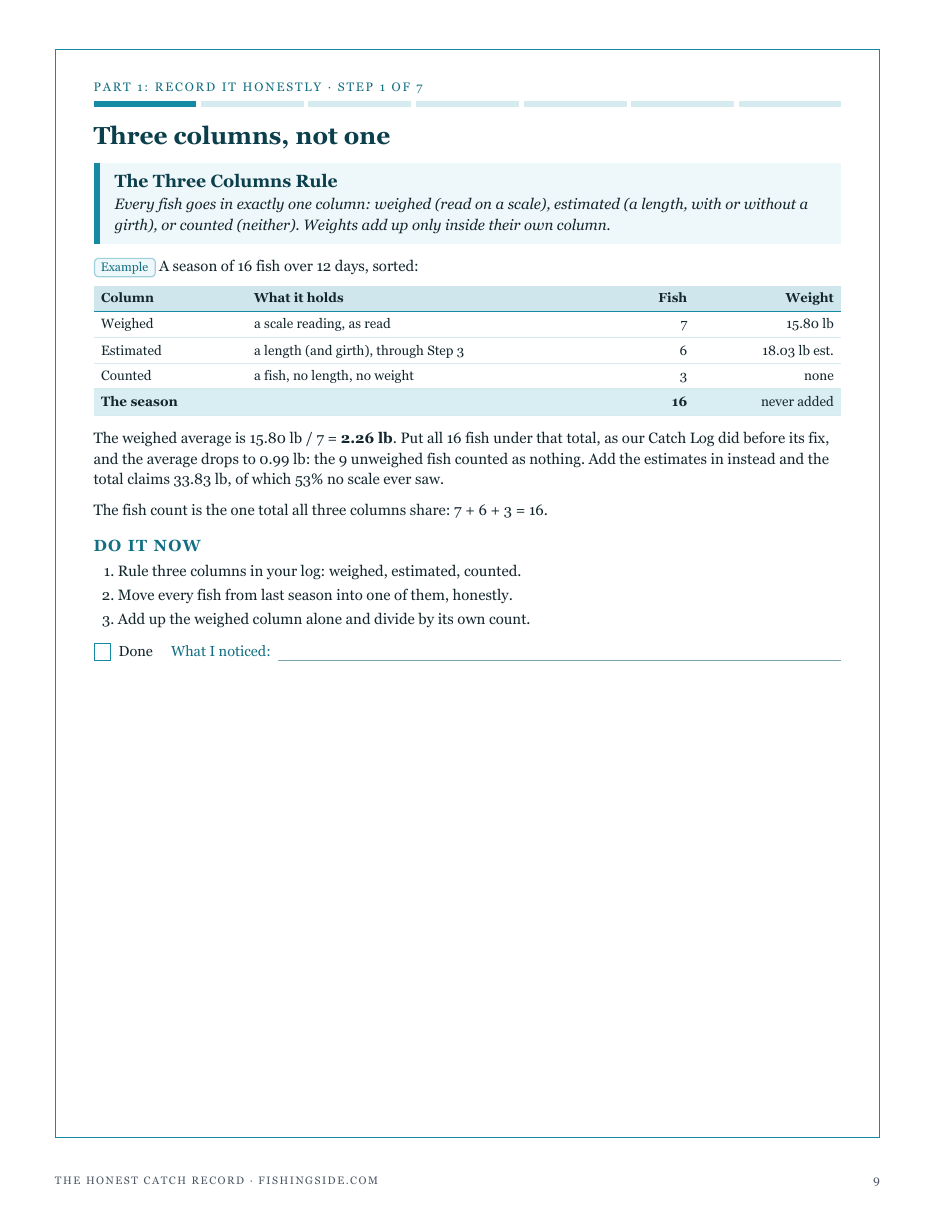
FishingSide's Catch Log Tracker counts your fish and averages only the ones you weighed; its Fish Weight Calculator turns a length into the species' standard weight, or a girth into an estimate; its Fishing License Checker points to your state's agency. Nothing on the site keeps a weighed fish apart from an estimated one, ranks a personal best, or checks a fish against the limits that apply. Writing this pack we fixed two of those tools: the Catch Log counted a fish released unweighed as 0 lb, and the Fish Weight Calculator put a 20 in bass at 6.67 lb and a 26 in channel catfish at 14.65 lb from length alone, well above their published standard weights of 4.69 lb and 6.79 lb. The Honest Catch Record works a season through. In its worked example 16 fish over 12 days sort into three columns: 7 weighed at 15.80 lb (a weighed average of 2.26 lb, not the 0.99 lb an all-fish average gave), 6 estimated at 18.03 lb est. kept on their own line, and 3 only counted. A 13.6 in bass is written down as 13.5 in, so it can never round up past a 14 in line it does not reach. The weight best is the 4.20 lb bass on the scale, not the 7.81 lb girth estimate a mixed column would crown; the length ladder holds one measured best per species. A relative weight check (100 x scale / standard weight) reads 90 for that bass and 895 for a slipped decimal point. Every figure is computed by the site's own Catch Log Tracker and Fish Weight Calculator and the formula on each page; the season and the limits are examples, not anyone's catch and not any state's rules. It states no limit of its own and gives no legal verdict on a fish; handling is quoted from Texas Parks and Wildlife's catch and release tips. Included: 24 printable pages with seven steps, four working pages, a standard weight table and a quickstart, plus a personalised sheet worked on your own fish, catch log and state.
Look inside
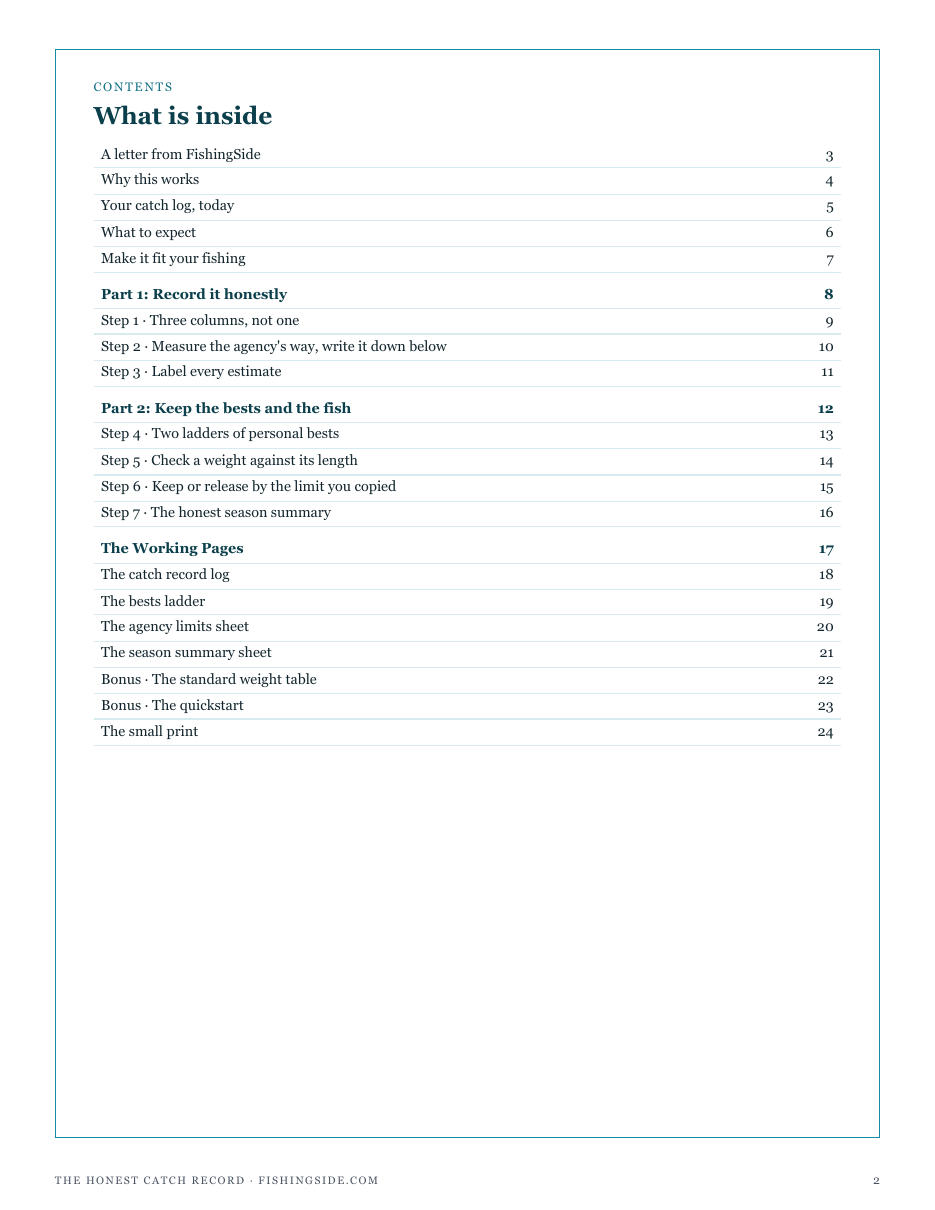
Two full pages from the record, exactly as printed. Click either to read it at full size before you decide.
What is in it
- Step 1: three columns, not one: weighed, estimated and counted fish, with weights added only inside their own column
- Step 2: lengths measured the agency's way and written to the quarter inch below, so a rounded length never crosses a limit
- Step 3: a label on every estimate, girth formula or standard weight, and never a move into the weighed column
- Step 4: two ladders of personal bests: weight from a scale only, length from a tape or board for each species
- Step 5: the relative weight check (100 x scale / standard weight) that catches a misread scale or tape
- Step 6: keep or release by the limits you copied from your agency, checked on the measured length, with handling in the agency's words
- Step 7: an honest season summary: counts and rates for every fish, weights by column, bests from the ladders
- Four working pages: a catch record log, a bests ladder, an agency limits sheet and a season summary sheet
- A standard weight table for seven species at fifteen lengths, and a quickstart that closes the score loop
- A personalised sheet: your fish's written length, both estimates and its relative weight band, your log in three columns, and your agency's page with what to copy
- ✓ 24 printable pages
- ✓ 10 sections, worksheets and templates
- ✓ A second PDF worked out from the numbers you enter
- ✓ No account needed, just an email address
- ✓ Instant download; link valid 7 days
Price includes any taxes. Sold by GrabURL, who handle checkout and support. The charge appears on your statement as GrabURL.
The record picks up where the free Catch Log Tracker leaves off. The tracker counts your fish and averages only the ones you weighed; the Fish Weight Calculatorgives a species’ standard weight for a length, or a girth estimate; the Fishing License Checkerpoints to the agency whose limits apply. Nothing keeps a weighed fish apart from an estimated one or ranks your bests. The record does: three columns (weighed, estimated, counted), lengths written down the agency’s way and never rounded toward a limit, every estimate labelled with its method, a weight best set only on a scale and a length best for every species, a relative weight check that catches a misread scale, keep or release checked against the limits you copied from your agency, handling quoted from a state agency’s catch-and-release guidance, and an honest season summary. It states no limit of its own, and every figure in it is an example for you to replace with your own.